Body Mapping Exercise: A Simple Observation Page
A body mapping exercise uses a simple outline to record what you notice in your body at one moment. It can be as modest as marking where a chair touches your back or where a sleeve feels warm. The drawing is a personal observation page, not a medical diagram, trauma map, or explanation of why a sensation exists. You can leave the outline mostly blank.
Decide what the map is for
Start by writing a purpose above the page: “Notice ordinary contact after sitting at my desk.” This is narrower and more practical than “Find everything wrong with my body.” Choose a time when you can stop easily. Keep your eyes open, and place the page where you can look back toward the room whenever you want.
You do not need to search every body part. Select one accessible, neutral area such as your hands resting on a table, or simply note where clothing touches your arm. If looking inward feels uncomfortable, you can map external contact only. Another option is to skip the body outline and draw the chair, desk, or room instead.
Set up an outline without artistic pressure
Draw a loose oval for the head, a rectangle for the torso, and lines for arms and legs. Alternatively, write a list of areas in the margin. Precision does not improve the observation. Leave enough space for labels, the date, and a sentence about context. A small legend can distinguish warmth, pressure, contact, and “not sure.”
Use symbols you can read later. A dot could mean a location; a wavy line could mean movement; an open circle could mean uncertainty. If color is useful, choose your own meanings and write them down. Red does not have to mean danger, and blue does not have to mean calm. Your map should not borrow diagnostic authority from a color scheme.
Describe before interpreting
Try words such as warm, cool, light, heavy, still, moving, supported, or hard to describe. A factual label might be “pressure at the back of my legs from the chair.” An interpretation would be “this proves I am stuck in a stress state.” Keep the first kind of sentence and leave the second as a question, if you record it at all.
Some sensations are difficult to name. “Unclear” is a complete answer. You do not need to identify an emotion, a memory, or a cause behind each mark. Likewise, a blank area does not mean that you have lost awareness there. This exercise is not a neurological assessment, and the outline cannot tell you whether a symptom is harmless.
Work through an everyday example
Imagine Alex returning from a grocery trip. Alex writes “just carried two bags” at the top of the page, marks ordinary warmth in the hands, and notes contact from shoes. There is no attempt to uncover a hidden explanation. The next note says, “Put bags away before sitting; choose a chair with back support.”
Later in the week, Alex makes another page after reading. The marks differ. That difference is a record of two separate contexts, not evidence that the exercise repaired anything. You can compare which descriptions were easiest to write and whether the page helped identify a practical preference. Comparing maps does not require comparing your body's performance.
Add a boundary and an exit
Write a stopping option on the sheet before you begin: “If this feels unpleasant, I can put the page down and look around.” You can also add an external prompt such as identifying the nearest window or reading the title of a book. This makes stopping part of the design instead of something that feels like failure.
Do not repeatedly focus on painful, frightening, or unfamiliar sensations to complete the drawing. New, severe, persistent, or concerning symptoms deserve appropriate medical attention rather than interpretation through a workbook. If body observation brings up difficult experiences, a qualified professional can help you decide whether and how to use it. You do not need to push through.
Review the page as a note, not a verdict
At the end, answer two questions: “What was easy to describe?” and “Would I use this format again?” You might prefer a written list, a larger outline, or no body-focused prompt at all. Keep only the information you find useful. There is no obligation to preserve a private page or show it to anyone.
If you share a map with a clinician, explain that it records your own words at a particular moment. Do not present the legend as a validated scale. For a more outward-focused option, try grounding techniques. To organize occasional notes without constant checking, see the self-care tracker guide.
Keep the scope clear
The NIMH self-care guidance places self-care alongside mental health support and treatment. The drawing method here is an original journaling format. It is not a claim that a body map can locate stored trauma, reveal a nervous system state, or select treatment.
Product format and boundaries
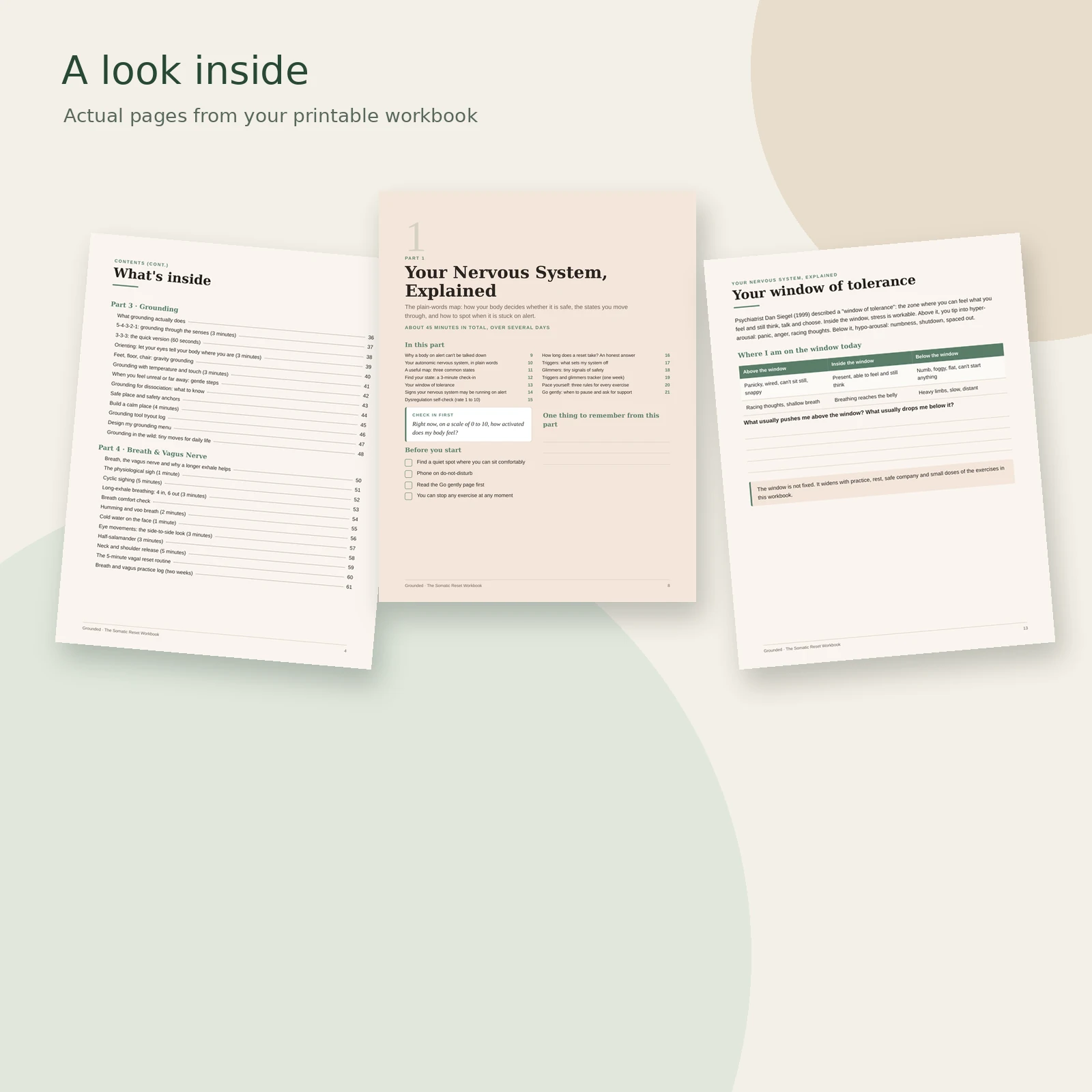
Grounded — The Somatic Reset Workbook is a self-guided product with a 130-page main workbook. Its included bonuses are a 21-page SOS resource and a 50-page tracker, plus a companion webapp. Those are format and inclusion details, not evidence of a health outcome. The separate card deck, wind-down routine, 28-day program, and movement library are extras, not part of this base bundle.
You can use a written resource to organize prompts, choices, and personal notes. You do not need to finish every page, share private entries, or produce a particular sensation. Ivy is a brand persona, not a therapist. The standard 365-day money-back guarantee concerns the purchase; it does not promise symptom improvement or a timetable for recovery. Check the product details and refund terms before deciding whether the format fits your needs.
Self-care has limits
These examples are educational self-observation activities, not diagnosis, individualized medical advice, or trauma treatment. Stop any practice that feels distressing or physically uncomfortable. Self-care can complement professional care; it should not delay getting help for persistent, worsening, or concerning difficulties. A qualified health professional can help you decide what is appropriate for your circumstances.