Gentle Breathing Exercises Without Forcing
Gentle breathing exercises for stress begin with permission to breathe comfortably. You do not need the largest possible inhale, a long breath hold, or a perfect rhythm. If paying attention to breathing feels unpleasant, you can choose an external grounding prompt instead. This guide is a self-care reading and note-taking exercise, not a treatment for anxiety, a lung condition, or another medical problem.
Start with comfort rather than a target
Choose a supported position that is already comfortable for you. Loosen restrictive clothing only if you want to and can do so conveniently. Keep your eyes open if that helps you stay oriented. Before changing anything, ask whether a breathing exercise is welcome right now. Choosing no is a complete response, not a sign that you need more practice.
The NHS breathing guide emphasizes gentle breathing without forcing. That principle matters more than copying an impressive count from social media. Follow any relevant medical advice you have received. If you have questions about whether a breathing practice is appropriate for a condition, ask a qualified professional.
An optional, uncomplicated approach
Let your breathing remain comfortable. You can notice an ordinary breath without enlarging it. If counting feels easy, use a light count only as an organizational aid, with no need to reach a particular number. There is no requirement to match someone else's pace or to continue until you feel calm.
A useful written prompt is: “Comfort first; no breath holding; I can stop.” Place it where you can read it without bending into an awkward posture. Skip breathing attention if it leads you to strain, gulp air, or monitor every sensation. Return to looking at the room and allow your breathing to proceed without deliberate management.
Understand what counting can and cannot do
A count can help you remember the order of an activity. It does not tell you how much air your body needs. If a number makes you stretch an inhale or delay an exhale uncomfortably, drop the number. You do not have to complete a pattern to earn permission to stop.
For example, Sam writes “notice one comfortable breath, then look at the window.” Sam does not use a timer or log a respiratory rate. On another day Sam chooses to describe the window instead. This is an example of adapting a prompt, not evidence of a particular effect on stress. The page records a choice rather than an outcome claim.
Keep a non-breathing alternative beside the prompt
Write down three ordinary observations: the color of a nearby object, the shape of the doorway, and the sound of a familiar appliance. If breathing attention feels uncomfortable, choose one of these and end the breathing activity. You do not need to explain why an alternative suits you better.
This is especially useful when following a recording that includes several methods in a row. Pause the recording instead of being carried into breath holds or stronger techniques you did not intend to try. A short written prompt gives you control over the sequence. You can also decide that no guided breathing format belongs in your personal routine.
Use a worksheet for preferences, not performance
Create three lines: “Setting,” “Prompt,” and “Would I choose this again?” A sample entry might say, “Living room; noticed comfortable breathing; preferred looking outward.” Another might say, “Desk; skipped counting; simple reminder was easier.” You do not need oxygen readings, breath totals, or a score for how regulated you felt.
Avoid comparing your entries to someone else's breath length. Bodies, health circumstances, and preferences differ. The purpose of the note is to identify wording you find acceptable, not to train yourself toward a universal rhythm. If logging makes breathing feel like a task you cannot leave alone, stop using the log.
Know when to leave the exercise
Stop if you feel dizzy, strained, increasingly uncomfortable, or short of breath. Do not try to fix that response by breathing harder or holding longer. Concerning, new, severe, or persistent symptoms call for appropriate medical attention, not a worksheet explanation. An online guide cannot tell you whether a physical symptom is caused by stress.
The NCCIH relaxation overview explains that relaxation techniques may not suit everyone and should not replace conventional care. This is why a gentle exercise includes an exit. Doing less, choosing an outward prompt, or asking for support can all be reasonable decisions.
Add it to a routine only if you want it there
A breathing prompt does not need to appear in every self-care session. If it feels suitable, place it as one optional choice in a simple daily routine. If it does not, use grounding with visible objects. A workbook is useful when it helps you keep those choices clear, rather than prescribing a mandatory response for every stressful moment.
Product format and boundaries
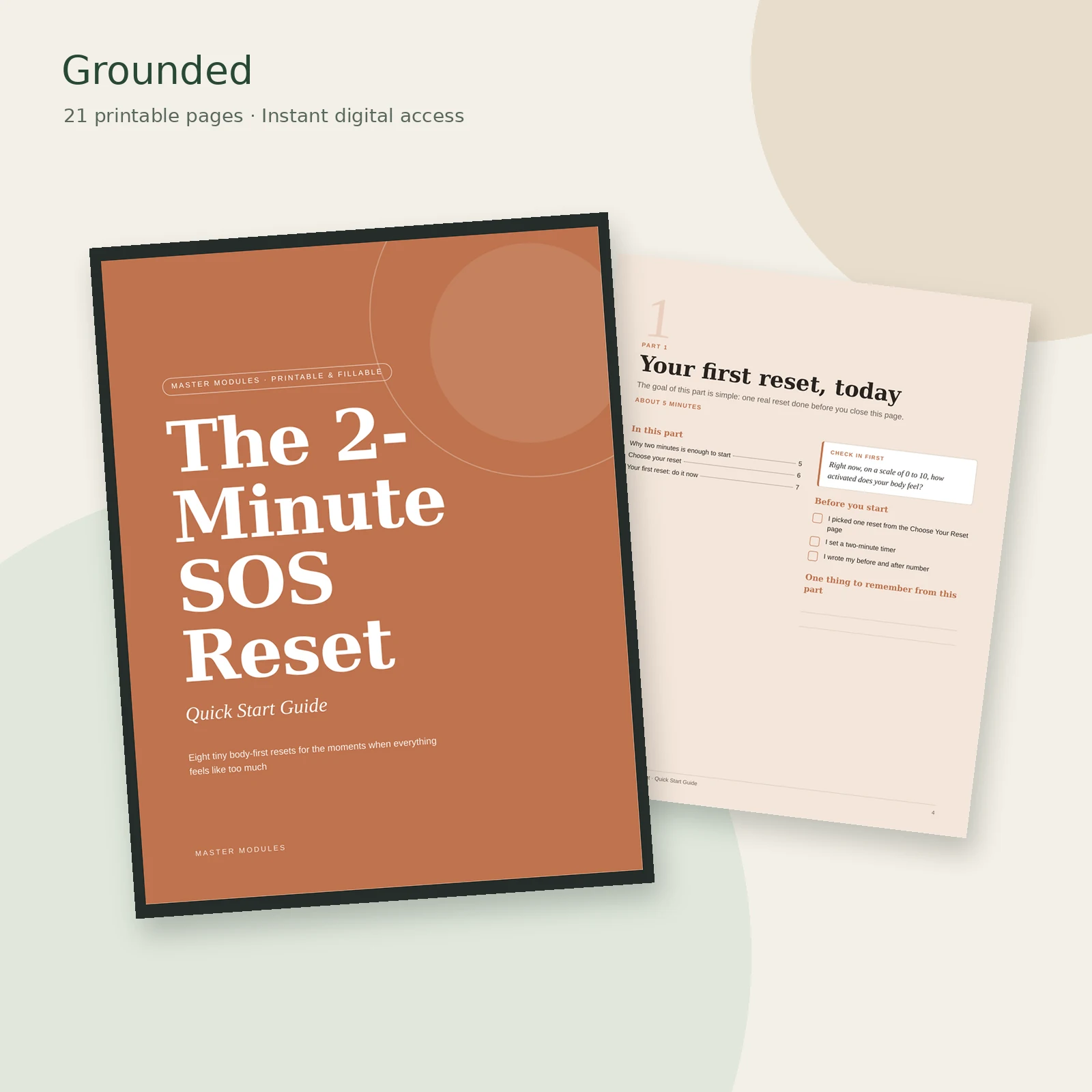
Grounded — The Somatic Reset Workbook is a self-guided product with a 130-page main workbook. Its included bonuses are a 21-page SOS resource and a 50-page tracker, plus a companion webapp. Those are format and inclusion details, not evidence of a health outcome. The separate card deck, wind-down routine, 28-day program, and movement library are extras, not part of this base bundle.
You can use a written resource to organize prompts, choices, and personal notes. You do not need to finish every page, share private entries, or produce a particular sensation. Ivy is a brand persona, not a therapist. The standard 365-day money-back guarantee concerns the purchase; it does not promise symptom improvement or a timetable for recovery. Check the product details and refund terms before deciding whether the format fits your needs.
Self-care has limits
These examples are educational self-observation activities, not diagnosis, individualized medical advice, or trauma treatment. Stop any practice that feels distressing or physically uncomfortable. Self-care can complement professional care; it should not delay getting help for persistent, worsening, or concerning difficulties. A qualified health professional can help you decide what is appropriate for your circumstances.