How to Use a Regulation Tracker Without Scoring Yourself
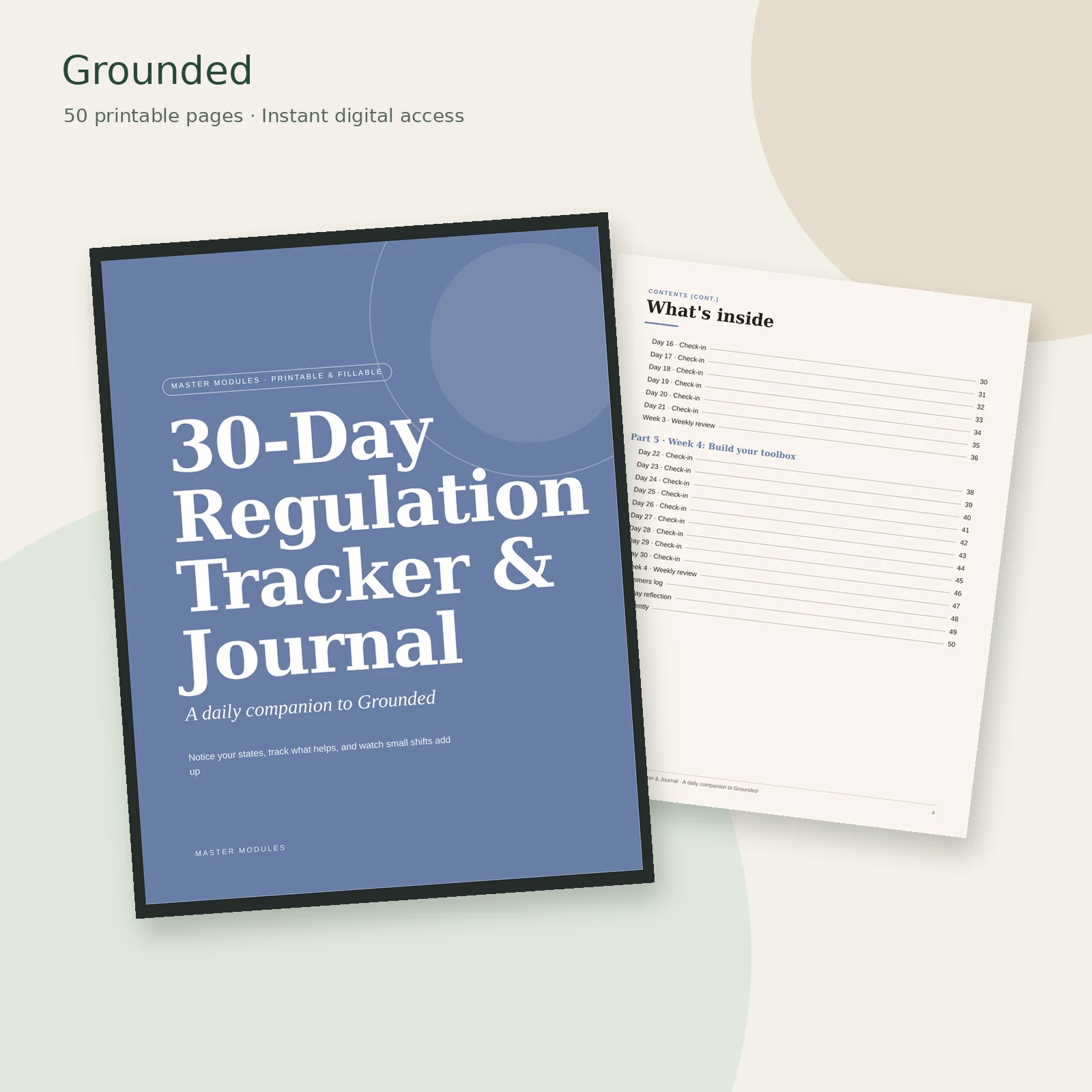
A regulation tracker can be a simple record of what you tried, when you tried it, and whether you would choose it again. It does not need to become a daily performance score. The most useful entries are often brief descriptions of ordinary circumstances: a busy afternoon, a comfortable chair, a prompt that took too much effort, or a page you wanted to revisit. This guide shows how to organize that kind of record without treating it as a diagnostic instrument.
Decide what question the tracker will answer
Choose one practical question before creating columns. You might want to remember which prompt fits a work break, whether you prefer writing before or after dinner, or which pages you actually open. These questions concern the usability of a routine. They do not require you to prove that you have changed a biological state or recovered from a condition.
Write the question on the first page. For example: “Which short reflection format will I realistically use after work?” That gives the tracker a purpose and a stopping point. Once you have enough notes to choose a format, you can simplify the tracker or stop recording for a while. A notebook is allowed to serve a temporary purpose.
Start with four small fields
A basic entry can contain the date, the situation, the prompt chosen, and a short note. On a paper sheet, leave one line for each. In a digital note, use the same labels in the same order. Consistency makes a later review easier, but the record does not have to look neat or contain complete sentences.
A sample entry could read: “Tuesday; finished a long call; looked at one object near the desk; easy to follow, would use again.” Another could read: “Thursday; tired; skipped the body map; preferred making tea.” Both describe a decision and context. Neither is a success or failure score, and neither requires an explanation of why you felt a certain way.
Use numerical ratings cautiously
Some trackers offer a zero-to-ten scale. If you want to use it, define the endpoints in words that make sense to you. For instance, the scale might describe how settled you feel at that moment. Keep the wording stable so that your entries are at least answering the same personal question over time.
An informal rating is still not a clinical test. A change from one number to another cannot tell you what caused the change, and a stable number does not mean that you performed a practice incorrectly. You can use words instead, leave the field blank, or record only whether the page was comfortable to use. Do not let the scale become the main reason to continue an activity.
Record context without building a surveillance project
Choose only a few details that help answer your practical question. Location, time available, and the format used may be enough. Recording every sensation, meal, conversation, and thought can create more work than the tracker saves. It can also make an ordinary fluctuation feel like something that needs constant analysis.
For example, a note that says “public place, preferred external observation” may be more useful than a long description of physical sensations. Keep the record proportionate to the decision you want to make. If close monitoring itself feels distressing or consuming, stop using the tracker and consider discussing that experience with appropriate support.
Make room for skipped days
A missed entry is missing information, not a debt. You do not need to reconstruct several days from memory or double the next practice to catch up. You can simply write “not recorded” and continue with the next occasion. A tracker that makes absence visible without judgment can be easier to maintain than a streak you feel responsible for protecting.
If you repeatedly skip the same field, ask whether the field is useful. Perhaps the prompt takes too long, the notebook is inconvenient, or a daily schedule does not suit your life. Change the system rather than assuming you need more discipline. The purpose is to support a routine, not to create another obligation.
Review for practical patterns once a week
Choose a short review window rather than rereading every entry after each practice. Look for repeated comments about convenience, clarity, and preference. You might notice that a single instruction works better for you than a long sequence, or that you use a printed card more often than a file stored several folders deep.
Turn a practical observation into one small adjustment. Put the chosen page closer to your workspace, shorten an entry, or keep the same prompt for another week. Avoid interpreting a few notes as proof of a medical effect. Workload, sleep, relationships, environment, and other forms of care can all influence how a day feels, and a simple tracker cannot isolate those factors.
Keep personal notes private
Before writing sensitive details, decide who could read the record. A shared device, a synchronized folder, or a notebook left on a table may be accessible to someone else. Neutral descriptions can be enough for your purpose. You do not need to record names, private memories, or information about another person to make a useful routine log.
If you use the Grounded companion app, notes stay with the relevant browser storage rather than becoming a universal record across every device. A printed page and a fillable PDF are separate records. Keep a blank original of any file you want to reuse, and check your own storage settings rather than assuming automatic backup or synchronization.
Using the included Grounded tracker
The entry bundle includes a 50-page Regulation Tracker and Journal alongside the 130-page main workbook, the 21-page SOS bonus, and the companion app. You can choose selected tracker pages instead of printing the entire file. Optional later programs are separate purchases; you do not need them to begin keeping a short record.
For general context, the NIMH self-care guide describes self-care as supporting mental health and existing treatment. A tracker can organize observations, but it does not replace assessment or individualized care. Read the workbook inventory if you want to compare the included files, or start with a small regulation routine if a daily record feels like too much.