Grounding Worksheets: A Practical Printable Guide
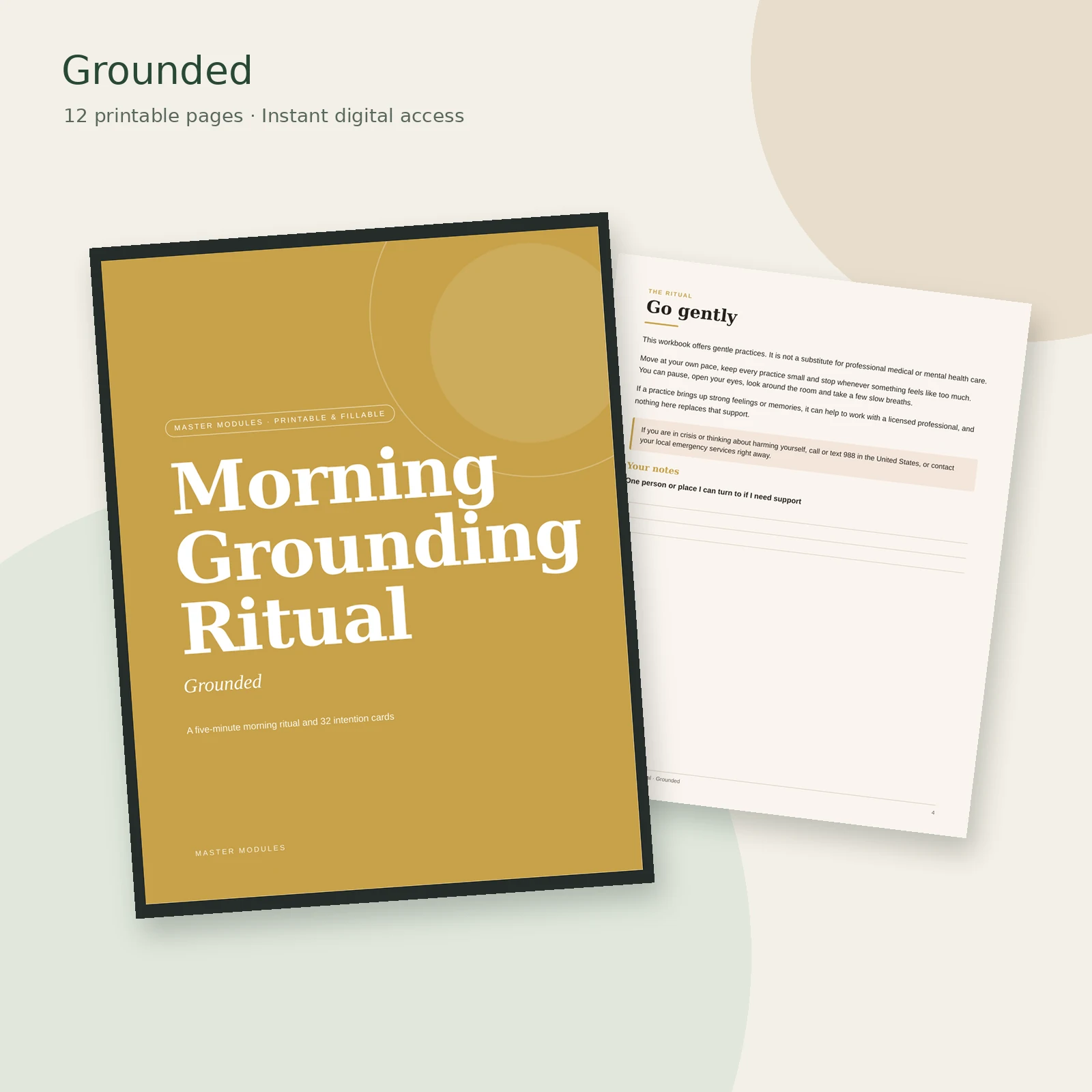
A grounding worksheet is a place to put a small set of instructions where you can find them again. Its practical advantage is organization: instead of searching through saved videos, you can open one page, choose a prompt, and record what you tried. The paper itself does not diagnose a condition, prove that your nervous system changed, or replace help from a qualified professional. This guide explains how to choose and organize printable grounding pages for ordinary self-care.
Decide what the page needs to do
Start with a situation rather than a collection size. Perhaps you want a short pause between meetings, a quiet prompt beside a journal, or a visible reminder to notice your surroundings. Write that situation at the top of a blank sheet. Then choose one task the page should support. A page that tries to explain every technique, track a month, and hold a long journal entry can be harder to use than a focused sheet.
For example, a desk page might have three boxes labeled “Where I am,” “What I notice,” and “My next ordinary action.” You could write “Kitchen table,” “Blue mug beside the laptop,” and “Close the document.” Those are observations and decisions. They do not require you to interpret a sensation or produce a particular emotional result.
Choose between instructions and reflection
An instruction sheet tells you what to try. A reflection sheet gives you room to describe an experience afterward. Keep their roles clear. During a busy moment, a long reflective question may feel like another assignment. Later, that same question might be useful in a quiet notebook. Neither format is more advanced; they serve different practical needs.
A simple instruction layout can use a title, a single optional prompt, and a clear stopping point. A reflection layout can use the date, the prompt chosen, a short description, and a note about whether you would choose it again. If you combine both, leave plenty of empty space and avoid making every box compulsory.
Make the text easy to find
Before printing a whole workbook, inspect a page at actual size. Can you read the instruction without leaning close? Is the writing space big enough for your handwriting? Does a dark decorative background use more ink than you want? Attractive screenshots do not always reveal whether a worksheet will be comfortable on ordinary home paper.
Print one selected page first. Check the printer setting for the intended paper size, and use a scaling option if the edges are clipped. A grayscale copy may be entirely sufficient for a text-based exercise. Put the test copy where you intend to use it, then decide whether you need another size or a simpler layout.
Build a small printable set
A useful starter folder can contain an orientation page, one sensory description page, and one short reflection page. That is enough to test the format. There is no need to print every available exercise at once. A thick binder can create a new selection problem if you cannot remember which page you wanted.
Label the first page with a practical name, such as “After work pause.” Keep the others behind it. If you prefer cards, copy only the essential instruction onto a smaller piece of paper while keeping the fuller explanation accessible. Avoid reducing text so much that it becomes difficult to read when you actually need it.
Adapt sensory prompts without making a test
Some grounding pages use numbers to structure attention, such as noticing several things you can see or hear. Treat the structure as a prompt, not a score. You do not have to find a smell, taste something, close your eyes, or continue a category that feels uncomfortable. An external description can be a complete activity by itself.
For instance, you might describe one nearby object by its color, shape, and position. Then stop and choose your next task. You can learn more about this present-focused approach through the VA PTSD Coach grounding activities. An online example is not individualized care or a reason to ignore symptoms that need assessment.
Use a short record rather than a success score
After trying a page, record what happened in ordinary language. “Easy to follow,” “Too much writing,” “Preferred looking around,” and “Did not want to continue” are all useful notes. An unchanged feeling does not mean that you failed. You are learning whether a particular page fits a particular situation.
If you like a numerical check-in, define the scale in your own words and use it consistently. Do not turn an informal rating into a clinical measurement. One number cannot establish why you felt different, and changes in sleep, workload, environment, or support may matter more than the page you happened to use.
Protect the privacy of printed notes
Think about where completed sheets will live. A page on a shared desk may be easy to reach but also easy for someone else to read. You can use a neutral cover sheet, keep personal reflections in a closed folder, or choose brief factual notes instead of sensitive details. You do not owe anyone access to a self-care notebook.
For digital worksheets, check where your PDF reader saves changes and whether it automatically synchronizes files. Save a blank original before writing into a copy. A companion app and a fillable PDF may store information differently, so do not assume that a note entered in one place appears in the other.
Where Grounded fits
Grounded includes a 130-page main workbook, the 21-page 2-Minute SOS Reset, a 50-page Regulation Tracker and Journal, and a companion web app. Those included items offer instructions and places to record observations. The card deck and later programs are optional paid extras, not part of the entry bundle. You can print selected pages or use the fillable files digitally.
Choose the format because you want a structured collection, not because a page count promises a health outcome. The standard guarantee is 365 days. If you are comparing formats before buying, read the workbook selection guide and the beginner practice guide. For concerns that are persistent, severe, new, or difficult to manage, seek appropriate professional support rather than relying on a printable sheet.